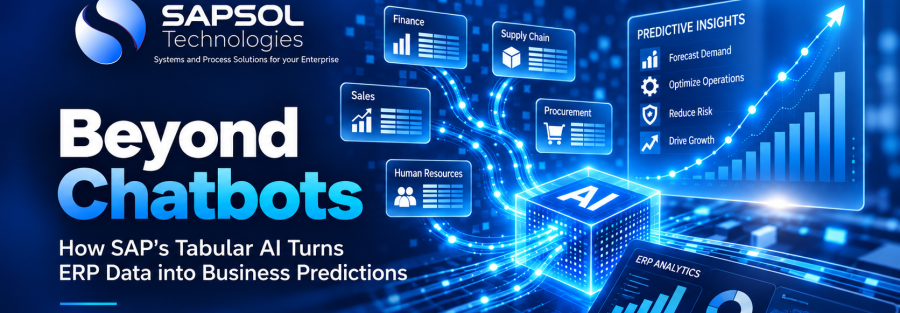
Updated October 20, 2026. Enterprise AI is moving beyond chat interfaces. The next competitive advantage may be the ability to anticipate payment delays, supplier disruptions and demand changes using data that already lives inside ERP systems. SAP’s latest advances in tabular AI make this conversation especially relevant for finance, supply chain and technology leaders.
On October 19, SAP published “The Gap That No LLM Can Close”, explaining why large language models (LLMs) and predictive models for structured business data address different problems. SAP had previously announced TabPFN-3.5 Plus availability in SAP AI Core on September 15, 2026. For SAP-driven enterprises, these developments present an opportunity to revisit where AI can create measurable value—and where preparation is still required.
Key takeaways for SAP and ERP leaders
- Different tools solve different problems. LLMs work well with language and knowledge. Tabular foundation models address predictions from structured data.
- High-value applications are operational. Examples include payment-delay prediction, supplier-risk scoring, customer churn and potential upsell identification.
- TabPFN-3.5 Plus is a real SAP AI Core offering. SAP documents classification and regression workflows, deployments and prerequisites.
- Prediction is not autonomous decision-making. A model’s output still needs validation, ownership, access controls and, when appropriate, human review.
- Start with a business KPI, not a model demo. Choose one measurable decision, establish a baseline and test whether predictions lead to better outcomes.
What is tabular AI, and why should SAP teams care?
Enterprise applications hold large amounts of structured data: invoice dates, purchase orders, payment histories, inventory movements, maintenance records, materials, transaction statuses and more. Such data is often organized into rows and columns connected by business identifiers and relationships.
Tabular AI is a broad category of machine learning focused on learning from this structured information. A tabular foundation model is a general-purpose model designed to support multiple prediction tasks without requiring a wholly separate, bespoke model-building effort for each use case.
Consider a finance team that wants to understand which receivables are likely to become overdue. An LLM might summarize a customer’s correspondence or explain credit policy. A tabular prediction model can instead evaluate patterns from labeled historical transactions and associated features to estimate future outcomes. These functions complement one another; neither automatically replaces sound business rules.
What did SAP announce in September and October 2026?
TabPFN-3.5 Plus in SAP AI Core
In its September 15 announcement, SAP said TabPFN-3.5 Plus from Prior Labs became available to SAP customers through SAP AI Core. SAP described the model as supporting predictions on structured business data with reduced traditional training and preprocessing effort, including mixed data types and missing values.
The SAP Help Portal documents classification and regression use cases, deployment requirements, supported input limits and example requests. It states that teams need an SAP AI Core instance and the extended service plan to use the generative AI hub. Model availability and contractual conditions should be verified for the customer’s environment.
A wider strategy for structured business predictions
In its October 19 article, SAP highlighted the role of tabular foundation models alongside LLMs and referenced its SAP-RPT model family, SAP Knowledge Graph and Prior Labs. The strategic idea is straightforward: businesses need models that understand their structured operational context, not only assistants that generate text.
This does not mean that every company can immediately connect a model to any ERP table and obtain reliable forecasts. The choice of target, quality of historical labels, time ordering, data access, privacy rules and business validation remain critical.
Five potential SAP and ERP use cases
1. Predict late customer payments
Accounts receivable teams could investigate whether payment history, invoice characteristics, customer segments and order patterns help flag invoices that deserve earlier review. The goal would be to prioritize collectors’ work, not to automatically penalize customers.
Useful measures: precision of high-risk alerts, time spent building worklists, collection effort per account and change in overdue balances.
2. Identify supplier and procurement risks
Procurement teams may be able to examine delivery history, order variability, lead times and quality outcomes to spot suppliers requiring investigation. Any system-generated risk label should be checked against current contract terms and real-world conditions before a sourcing decision is made.
Useful measures: missed delivery alerts, false positives, days of disruption prevented and buyer response time.
3. Improve inventory and demand decisions
Manufacturers and distributors can evaluate whether historical transactions, product patterns and operational features support better early-warning signals for stockouts or excess inventory. Tabular predictions can complement existing planning methods rather than displace enterprise planning controls.
Useful measures: forecast error, stockout frequency, inventory carrying costs and planner intervention rates.
4. Detect customer churn and upsell opportunities
Sales operations teams may combine transactional and account-level information to assess where proactive account engagement is warranted. Such models should be evaluated carefully for bias, stale records and misleading proxies.
Useful measures: alert accuracy, account-retention impact, opportunity conversion and whether recommendations help rather than overwhelm sales teams.
5. Support maintenance and operational triage
In asset-intensive operations, historical service patterns and transaction data may support supervised prioritization of cases for engineering review. Safety-critical recommendations should never bypass engineering controls or authorized human judgment.
Useful measures: triage time, precision of risk categorization, avoidable work orders and verified decision quality.
Tabular AI versus traditional machine learning and LLMs
| Approach | Best-suited question | Practical consideration |
|---|---|---|
| Large language model | What does this document, message or policy mean? | Needs grounding, access controls and factual validation. |
| Traditional predictive machine learning | Can a tailored model predict this specific outcome? | Often needs per-task feature engineering, training and maintenance. |
| Tabular foundation model | Can a reusable model predict outcomes from labeled structured data? | Still needs representative examples, testing and governance. |
No method is universally superior. SAP’s release positions tabular foundation models as a promising way to reduce some model-development overhead, but procurement decisions should be based on workload-specific tests and current documentation rather than marketing superlatives.
What should a company check before its first pilot?
- Define a decision. Pick a question such as “Which invoices are likely to be late?” and identify the person accountable for acting on predictions.
- Identify approved data sources. Map relevant SAP and non-SAP fields, ownership, permission boundaries and sensitive data.
- Build a credible historical evaluation. Separate past and future periods to avoid data leakage. Compare performance with simple business rules and existing models.
- Verify SAP AI Core prerequisites. Confirm region, availability, licensing, quotas, technical integration and information-security requirements.
- Measure business outcomes. Track precision, recall or prediction error alongside operational measures such as avoided rework or faster review.
- Begin with human-reviewed recommendations. Add write-back or automatic intervention only after approvals, audit trails, exception handling and rollback procedures are proven.
Why data and process readiness matter more than model selection
A sophisticated model does not compensate for incorrect master data or a poorly defined decision process. Many AI pilots fail to deliver operating value because no one owns the outcome, historical records contain inconsistent meanings, or the organization has no clear route from prediction to action.
A practical assessment should therefore look at data quality, integration architecture, process ownership, access controls and measurable business KPIs. These preparations also benefit SAP modernization programs that may later adopt more advanced automation and analytics.
How SAPSOL can support an enterprise AI readiness discussion
SAPSOL Technologies provides SAP and enterprise technology consulting, data management, cloud and integration capabilities. Depending on the client’s environment and confirmed scope, those disciplines can support a readiness assessment, integration planning, data preparation and design of a controlled AI proof of concept.
For organizations evaluating SAP-based AI initiatives, a useful starting point is a limited pilot: define the business problem, validate data suitability, test model performance against existing approaches and present a clear management decision before expanding.
Learn more about SAPSOL’s solutions or explore the Agentic AI Implementation Cost Estimator for adjacent automation-planning considerations. The estimator is not a quotation for TabPFN model usage.
Frequently asked questions
Is TabPFN-3.5 Plus available through SAP?
Yes. SAP announced its availability to SAP AI Core customers in September 2026. Deployment depends on the documented prerequisites and model availability in the relevant environment.
Does tabular AI replace SAP Joule or generative AI?
No. Models that predict from business tables and models that work with language serve different needs and can be combined within governed enterprise processes.
Can tabular AI guarantee a better forecast?
No. Performance depends on data quality, representativeness, changing business conditions, task definition and validation. Compare candidates against real baselines before making ROI claims.
Should predictions directly update ERP records?
For an initial pilot, human-reviewed decision support is usually safer. Any automated action requires explicit authorization, robust testing, monitoring and exception controls.
Conclusion: enterprise AI must become decision-ready
The most useful question for SAP leaders is not “Which AI model is newest?” It is “Which decision could we improve, with evidence, using data we already control?” Tabular AI broadens the options for answering that question. Organizations that combine structured predictions with reliable processes, governance and human judgment will be better positioned to turn AI experiments into operational value.
Official references: SAP News, October 19, 2026; SAP News, September 15, 2026; SAP Help Portal: TabPFN-3.5 Plus.