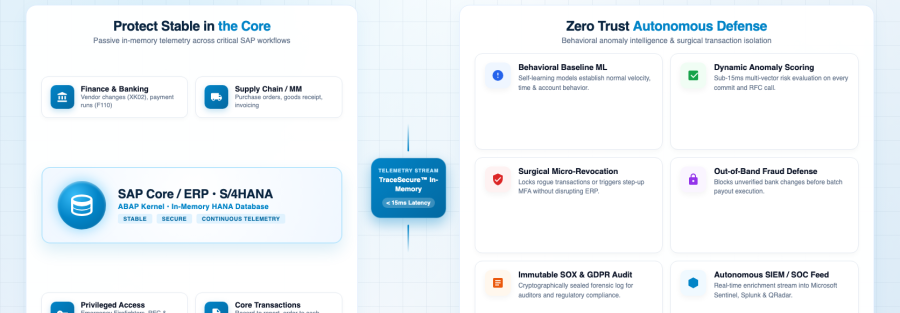
Over 74 percent of enterprise resource planning (ERP) security breaches do not originate from external brute-force intrusions or unauthenticated network penetration. They originate from within authenticated, authorized user sessions. In modern SAP S/4HANA landscapes, valid user credentials, legitimate role assignments, and scheduled background services execute fraudulent financial modifications, vendor diversions, and data extractions entirely undetected by traditional perimeter defense mechanisms.
To address this critical vulnerability gap, SAPSOL Technologies LLC has published a comprehensive 22-page executive playbook: Zero Trust in the Autonomous Enterprise: Safeguarding SAP S/4HANA Against Behavioral Anomalies & Insider Threat, featuring TraceSecure™.
In this article, we examine why traditional Governance, Risk, and Compliance (GRC) frameworks fail against behavioral deviations, how in-memory telemetry operates at line-rate speed, and how autonomous micro-revocation prevents catastrophic capital flight before payment runs execute.
The Architectural Paradox: The Perimeter Fallacy in SAP S/4HANA
For two decades, enterprise SAP security relied on two foundational assumptions:
- The Network Perimeter Barrier: Everything inside the corporate virtual private network (VPN) or enterprise Demilitarized Zone (DMZ) is trusted.
- Static Role-Based Access Control (RBAC): If a user possesses the requisite authorization objects in transaction SU53 and passes Segregation of Duties (SoD) audits, their business execution is inherently legitimate.
In the modern autonomous enterprise, both assumptions collapse under operational reality.
As organizations migrate from legacy ECC systems to SAP S/4HANA (whether Cloud Private Edition, Cloud Public Edition, or on-premise RISE deployments), the enterprise perimeter dissolves. Core business logic is exposed through SAP Business Technology Platform (BTP), OData application programming interfaces (APIs), third-party logistics integrations, and remote hybrid workforces.
“Access authorization is not behavioral integrity. A user possessing legitimate clearance to execute vendor maintenance (XK02) or release purchase orders (ME29N) can still execute an anomalous, unauthorized transaction that costs millions.”
When a trusted user’s session token is intercepted, when an administrator’s emergency Firefighter ID is misappropriated, or when a disgruntled internal controller alters supplier banking details minutes before an automated payment run, standard SAP authorization logs simply record a valid transaction. Traditional GRC audits only discover the discrepancy weeks or months later during post-mortem financial reconciliations.
The Three Pillars of Behavioral Zero Trust for SAP
True Zero Trust architecture for enterprise SAP requires abandoning implicit trust inside authenticated sessions. Every single transaction, Remote Function Call (RFC), and database commit must be continuously verified against dynamic baseline behavior.
Our whitepaper establishes an operational engineering framework built upon three foundational capabilities:
1. Passive In-Memory Kernel Telemetry
Traditional application monitoring solutions rely on batch log scraping, database table polling, or heavy host agents that degrade production throughput. In high-volume SAP S/4HANA environments processing millions of lines per hour, latency overhead is unacceptable.
The TraceSecure™ behavioral intelligence engine utilizes passive, non-intrusive ABAP kernel surveillance. Operating directly within the SAP HANA in-memory architecture, it captures 100 percent of dialog, RFC, and batch commits with an execution latency under 15 milliseconds, introducing zero measurable overhead to business end-users.
2. Dynamic Anomaly Scoring (DAS)
Instead of rigid boolean rule sets that generate overwhelming false-positive alert fatigue, behavioral Zero Trust employs unsupervised machine learning baselines. Every transaction is dynamically scored across multiple vectors:
- Velocity and Timing: Did the transaction occur outside normal operating hours, or at an unnatural speed suggesting automated robotic manipulation?
- Monetary Threshold Variations: Does the line item deviate significantly from historical moving averages for that specific vendor or material group?
- Session Geolocation and Fingerprint: Is the transaction originating from an unexpected IP address, device profile, or concurrent geographic location?
- Workflow Sequencing: Did the user modify sensitive master data immediately preceding an outbound payment proposal without customary review intervals?
3. Autonomous Surgical Micro-Revocation
When an anomaly score exceeds verified risk thresholds, legacy security systems face an impossible dilemma: either freeze the entire user account (shutting down essential plant operations) or merely email an alert that sits unread in an inbox while funds transfer.
Autonomous Zero Trust enforces surgical micro-isolation. The platform can isolate and cancel only the specific high-risk transaction commit, require out-of-band biometric Multi-Factor Authentication (MFA), or require secondary supervisor dual-control authorization, all without disrupting the remainder of the user’s legitimate daily workload.
Real-World Threat Scenario: The 8-Minute Vendor Bank Hijack
Consider a common, highly destructive insider threat scenario mitigated by behavioral Zero Trust:
Walkthrough: Intercepting Fraud in Transaction XK02 & F110
Step 1 (Legitimate Authentication): A senior accounts payable clerk with valid authorizations logs into SAP S/4HANA during regular office hours.
Step 2 (The Rogue Action): At 4:52 PM, eight minutes before the scheduled automatic batch payment run (F110), the user opens transaction XK02 and alters the International Bank Account Number (IBAN) of a Tier-1 industrial supplier to an offshore beneficiary account.
Step 3 (Traditional GRC Blindspot): Standard SAP authorization checks confirm the clerk has XK02 authorization. No security alert fires. The change is written to database table LFBK.
Step 4 (TraceSecure™ Zero Trust Intervention): TraceSecure™ evaluates the transaction. The Dynamic Anomaly Scoring engine detects a critical velocity-sequence anomaly: a high-value bank change executed immediately prior to batch proposal creation without an accompanying approved purchase order document. The risk score escalates to 94/100.
Step 5 (Autonomous Mitigation): In under 15 milliseconds, the system blocks the database commit for the payment run inclusion, preserves the previous verified bank record, sends an encrypted notification to the Corporate Controller, and triggers an out-of-band executive approval requirement. Capital remains secure within the enterprise treasury.
Regulatory and Compliance Governance Mapping
Beyond operational loss prevention, continuous behavioral Zero Trust satisfies the most demanding international compliance standards:
| Regulatory Standard | Governance Requirement | TraceSecure™ Architecture Alignment |
|---|---|---|
| SOX Section 404 | Internal controls over financial reporting and material misstatement prevention | Cryptographically sealed audit trail proving continuous verification across AP, AR, and GL postings |
| NIST CSF 2.0 | Continuous monitoring, behavioral anomaly detection, and automated mitigation | Sub-15ms threat detection and automated micro-revocation without human latency delays |
| GDPR Article 32 | Security of personal data processing and prevention of unauthorized exfiltration | Instant identification of mass query dumps and anomalous customer/employee table downloads |
Executive Summary: Preparing Your SAP Landscape for 2027 and Beyond
As global enterprises accelerate their transitions to SAP S/4HANA and clean core architectures, cybersecurity strategies must evolve from perimeter gatekeeping to continuous in-session intelligence. Relying exclusively on static access controls leaves enterprise ERP systems vulnerable to the fastest-growing attack vector in global business: authorized insider credentials executing unauthorized operations.
By implementing passive in-memory telemetry, machine-learned behavioral baselines, and surgical micro-revocation, organizations can safeguard their digital core while empowering employees with friction-free productivity.
Download the Complete 22-Page Strategic Whitepaper
Access the complete engineering blueprints, algorithm breakdowns, SAP S/4HANA telemetry integration guides, and forensic compliance checklists in our publication: “Zero Trust in the Autonomous Enterprise”.
About SAPSOL Technologies LLC: Headquartered in Santa Clara, California with Canadian delivery operations in Mississauga, Ontario, SAPSOL Technologies LLC provides enterprise SAP consulting, S/4HANA migration frameworks, and proprietary behavioral intelligence solutions through TraceSecure™. Contact us at info@sapsol.com or call +1 (343) 800-0733.