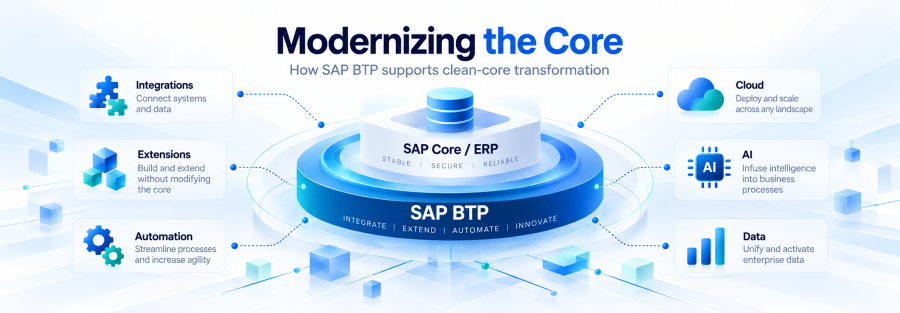
Enterprise modernization does not always require a full rip-and-replace of the SAP core. In many cases, the more sustainable approach is to keep the core stable while moving new integrations, extensions, automations, and digital experiences into a decoupled architecture.
This is where SAP Business Technology Platform (SAP BTP) has played an important role. In 2026, SAP positions SAP BTP capabilities as core components of the broader SAP Business AI Platform. The architectural principle remains highly relevant: extend and connect enterprise systems without turning every new requirement into a modification of the ERP core.
For organizations running SAP S/4HANA or other SAP applications, that approach can reduce technical debt, simplify upgrades, and create a more flexible foundation for future innovation.
Why Core Customization Becomes a Modernization Problem
Traditional SAP landscapes often accumulate years of custom code, point-to-point integrations, enhancements, and business-specific logic. Many of these changes solve genuine requirements, but over time they can make the environment harder to maintain.
The challenge is not customization itself. The challenge is tightly coupling every customization to the core system.
When custom logic is embedded directly into the ERP core, organizations may face more regression testing, more complicated upgrades, greater dependency on legacy objects, and slower adoption of new capabilities. SAP’s clean-core strategy addresses this by encouraging lifecycle-stable extensions and the use of released interfaces wherever possible.
What “Clean Core” Means in Practice
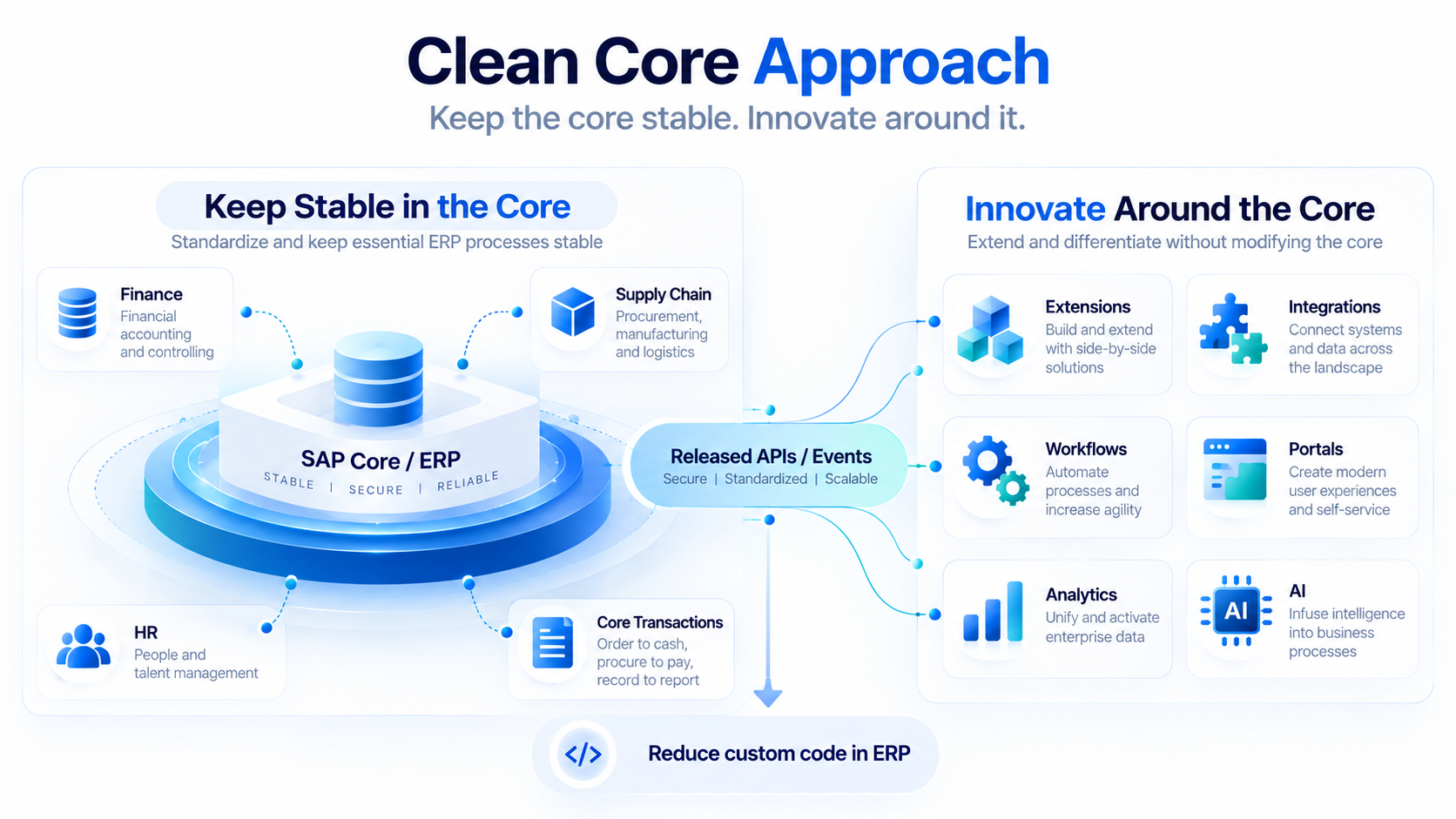
A clean core does not mean eliminating every extension or forcing every organization to use a completely standard process. It means making deliberate architectural choices about where custom capabilities should live.
SAP supports both on-stack and side-by-side extensibility. Side-by-side extensions run outside the SAP S/4HANA core and communicate through released APIs and business events. This separation allows the extension and the ERP system to evolve more independently.
For many transformation programs, this creates a practical middle ground: preserve the stability of the system of record while still giving the business room to innovate.
How SAP BTP Supports Modernization Around the Core
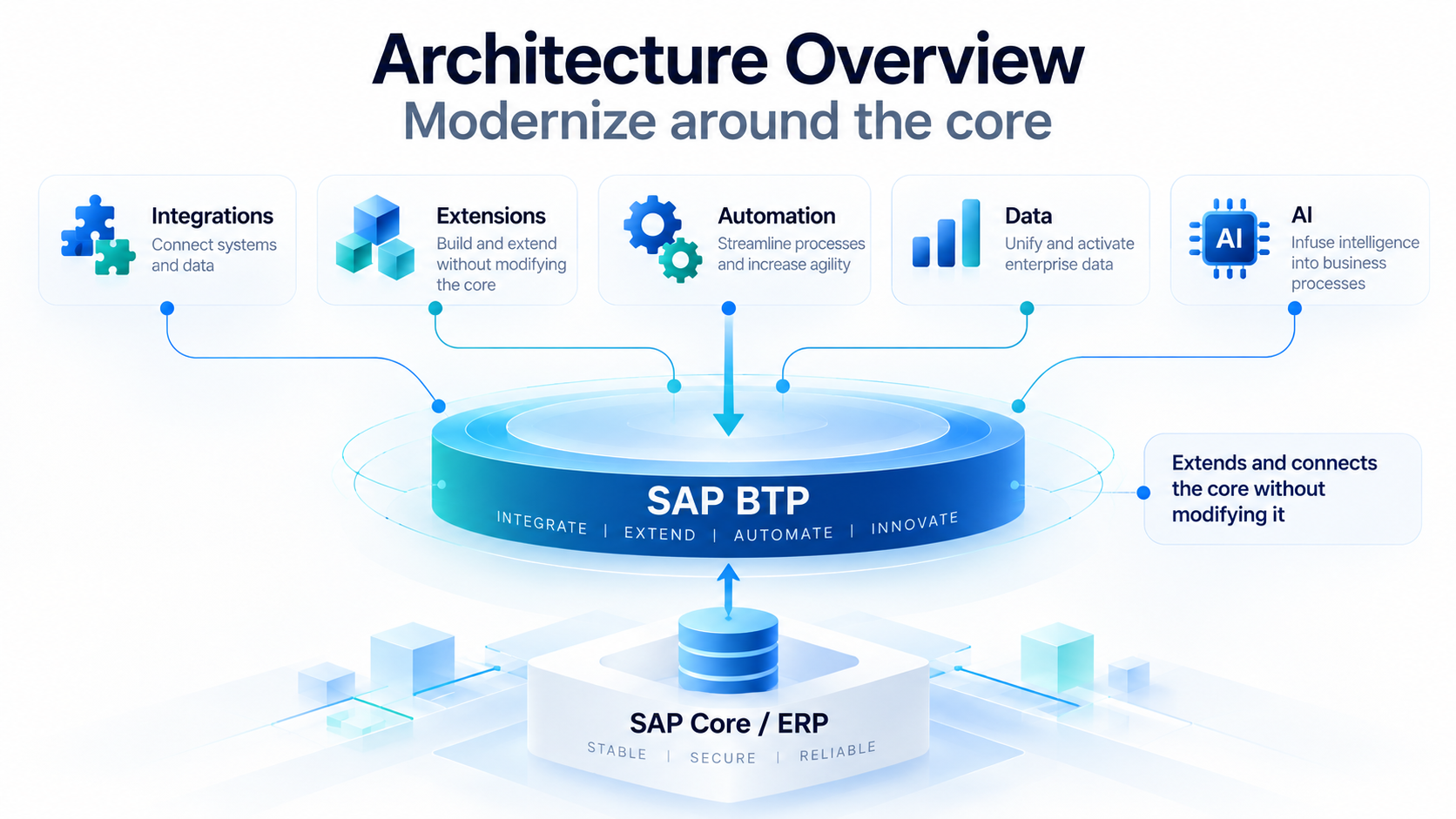
1. Connect SAP and Non-SAP Systems Without More Point-to-Point Complexity
Modern enterprises rarely operate a single application landscape. SAP systems often need to exchange data with CRM platforms, supplier networks, data platforms, industry applications, cloud services, and custom software.
SAP Integration Suite provides integration capabilities for connecting applications, data, APIs, events, and processes across SAP and third-party environments. A governed integration layer reduces the need to create another tightly coupled connection every time a new system is introduced.
This is especially useful when an organization wants to modernize its surrounding architecture while keeping the core ERP stable.
2. Build Side-by-Side Extensions Instead of Modifying the Core
Some business requirements are genuinely differentiating and cannot be solved through standard configuration alone. The question is where that custom logic should run.
With side-by-side extensibility, custom applications can run on the platform and access SAP business data through supported remote APIs and events. The custom application has its own lifecycle and can be scaled or changed without embedding all of its code inside SAP S/4HANA.
This model is useful for scenarios such as custom user experiences, supplier or customer portals, specialized approval processes, industry-specific workflows, and applications that combine SAP data with external data sources.
SAPSOL’s broader SAP solutions and services can be structured around this principle: keep system-of-record processes stable while placing differentiated capabilities in the right architectural layer.
3. Modernize Processes Without Rebuilding the ERP
Not every transformation requirement needs a new ERP implementation. Many organizations first need to improve how work moves across existing systems.
Integration, application development, workflow automation, and event-driven processes can be used to modernize selected business journeys without rewriting the underlying transaction system. This allows teams to address high-value process gaps incrementally instead of tying every improvement to a large core transformation program.
The result is a modernization roadmap that can be delivered in smaller, governed increments.
4. Create a Better Foundation for Data and AI
AI initiatives depend on access to reliable business context, governed data, and connected processes. A fragmented landscape makes that difficult.
SAP’s current platform direction brings together application development, integration, data, AI, process context, and governance through SAP Business AI Platform. For enterprises with existing SAP investments, this means modernization decisions made around integration and extensibility can also improve the foundation for future AI-enabled applications and workflows.
The important architectural point is that AI should not become another isolated layer. It should be connected to governed business processes and data with clear security and lifecycle controls.
Modernization Without a Full Rip-and-Replace: A Practical Example
Consider an organization running a stable SAP ERP environment with several custom integrations and a manual supplier onboarding process.
A traditional response might be to modify the core application again or wait until the next major ERP transformation. A cleaner approach could be to keep the existing core transaction process intact, create a side-by-side onboarding experience, integrate it with SAP through supported interfaces, automate selected approvals, and expose only the business data required by the new process.
The business gets a modern experience while the ERP core remains more stable and easier to manage.
This does not eliminate the need for future S/4HANA upgrades or core transformation where they are justified. It separates business innovation from the assumption that every innovation requires a core modification.
When SAP BTP Is the Right Fit
SAP BTP-oriented modernization is particularly relevant when an organization wants to:
- Reduce custom code and technical debt in the SAP core.
- Connect SAP and non-SAP applications through a governed integration layer.
- Create new applications or user experiences around existing SAP processes.
- Modernize selected workflows before a larger ERP transformation.
- Adopt a clean-core strategy while preserving necessary business differentiation.
- Build a stronger foundation for data, automation, and AI initiatives.
When the Core Still Needs to Change
Clean-core architecture should not be confused with avoiding necessary ERP work.
If the current system is unsupported, heavily constrained, unable to meet regulatory requirements, or structurally incapable of supporting the target operating model, a core upgrade or transformation may still be required. SAP BTP is not a substitute for fixing an unsuitable system of record.
The correct decision depends on architecture, business process requirements, data dependencies, integration patterns, and the lifecycle of the existing SAP environment.
A Practical Starting Point for SAP Leaders
Before choosing tools, organizations should map the current landscape and separate requirements into three groups:
- Core processes that should remain stable and standardized.
- Extensions that create differentiated business value but should be decoupled where practical.
- Integrations and automations that connect processes across SAP and non-SAP systems.
From there, teams can identify which customizations should remain, which should be redesigned, and which can move to a side-by-side or integration-led architecture.
This assessment is often more valuable than starting with a product checklist because it connects the platform decision to business outcomes and long-term maintainability.
How SAPSOL Can Support the Modernization Journey
SAPSOL Technologies works with organizations across SAP implementation, integration, cloud, application support, data, and modernization initiatives. A practical SAP BTP modernization engagement can begin with an architecture and customization assessment, followed by a prioritized roadmap for clean-core extensions, integrations, and process improvements.
For organizations already operating complex SAP landscapes, the goal should be controlled modernization: reduce unnecessary coupling, preserve critical business processes, and create an architecture that can evolve without repeatedly adding risk to the core.
Organizations evaluating their next step can also review SAPSOL’s SAP application maintenance and support services and cloud services as part of a broader modernization strategy.
Conclusion
SAP modernization does not need to be defined as a choice between leaving the existing landscape untouched and replacing everything at once.
By using clean-core principles, governed integration, and side-by-side extensibility, enterprises can modernize around the core while protecting the stability of mission-critical SAP processes. SAP BTP capabilities—now positioned within SAP Business AI Platform—provide an architectural foundation for that approach.
The strongest modernization programs start with the business process and architecture, not the technology label. The objective is a landscape that is easier to extend, easier to integrate, and better prepared for future change.