Why DDMRP Is the Answer to Supply Chain Volatility
In today’s fast-moving and unpredictable markets, traditional supply chain planning methods are increasingly falling short. Seasonality, sudden demand spikes, non-forecastable customer orders, and long, unreliable supplier lead times have made forecast-driven planning fragile and reactive.
This is where Demand-Driven Material Requirements Planning (DDMRP) comes in—offering a smarter, more resilient way to plan and protect supply chains against volatility.
What Is DDMRP?
DDMRP replaces forecast-driven push planning with actual demand-driven pull.
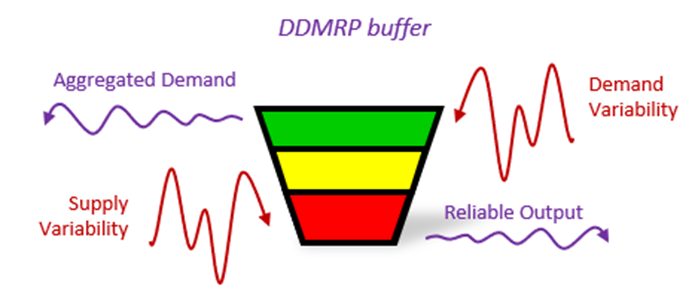
Rather than attempting to predict demand far into the future, DDMRP focuses on flow, availability, and responsiveness by using strategic buffers and decoupling points. These mechanisms protect the supply chain from uncertainty while ensuring materials are available when and where they are needed.
How does DDMRP function?
Strategic Buffer Stock
Decoupling points
Decoupled lead items
Dynamic Buffer Management
Real-Time Demand Signals
Business Outcomes of DDMRP
Higher material availability and service levels
Fewer stockouts of critical components
Reduced expediting and firefighting
Leaner inventory with better flow
Stronger protection against demand and supply volatility
How DDMRP Supersedes Traditional MRP
DDMRP improves on traditional MRP by replacing forecast-driven push planning with real demand-driven pull. Instead of relying on long lead times and uncertain forecasts, DDMRP uses strategic buffers and decoupling points to absorb variability and protect flow. This results in faster response, fewer stockouts, reduced firefighting, and a more resilient supply chain—especially in volatile and seasonal environments.
DDMRP in an SAP Environment
DDMRP is commonly implemented alongside SAP ECC or S/4HANA, often through add-ons or advanced planning layers. It is particularly effective for:
Manufacturing
Distribution
MRO environments
Long lead-time industries such as energy and heavy engineering
Conclusion:
DDMRP strengthens supply chains by strategically positioning buffer stock at decoupling points, managing decoupled lead times, and replenishing based on real demand—ensuring availability despite seasonality and unpredictable demand.
It is not about forecasting better. It’s about planning smarter.